
Free Testosterone vs. Total Testosterone: Why the Difference Matters More Than Your Lab Results Show
Your lab results come back. Your provider tells you everything looks fine, but you’re exhausted by noon, your libido has gone quiet, and the gym gains you used to take for granted have stalled out completely.
If that sounds familiar, you’re not imagining things. And your labs aren’t necessarily lying to you. The problem is that you may be looking at the wrong numbers.
Total testosterone is the figure most standard blood panels report, and it tells you how much testosterone is circulating in your body. However, it doesn’t tell you how much of that testosterone your body can actually use. That distinction belongs to free testosterone, and it’s where the real story of your hormonal health begins.
What Is Total Testosterone?
Total testosterone refers to the entire amount of testosterone circulating in your bloodstream at any given time. It includes three distinct forms:
- Testosterone tightly bound to sex hormone-binding globulin (SHBG)
- Testosterone loosely bound to albumin, a protein produced by the liver
- Free (unbound) testosterone — the small fraction that is biologically active
When your doctor orders a routine hormone panel, total testosterone is typically the only number measured. For many men, it’s the only number they’ve ever seen — and that creates a significant blind spot. A comprehensive hormone and metabolic panel goes much further, capturing the full picture your health decisions deserve.
What Is Free Testosterone?
Free testosterone is the fraction of testosterone not attached to any protein — roughly 1 to 3% of total testosterone in most men. Small as that percentage sounds, it’s the only form that can enter your cells, bind to androgen receptors, and drive the biological functions most men associate with healthy hormone levels: muscle growth, libido, energy, mood stability, and cognitive sharpness.
From a clinical standpoint, free testosterone is the number most closely tied to how you actually feel day to day.
A useful way to think about it: total testosterone is like the money you have in the bank. Free testosterone is the money in your wallet — the portion you can spend right now. The real question isn’t how much you have in total. It’s how easily you can access it.
Learn how to interpret your free-to-total testosterone ratio directly from Frenchye Bonds at our Savannah Lowcountry Male clinic.
What Is SHBG — and Why Does It Control Your Testosterone?
Sex hormone-binding globulin, or SHBG, is a protein produced primarily in the liver. Its job is to transport sex hormones — including testosterone and estrogen — through the bloodstream. When testosterone binds to SHBG, it becomes biologically inactive. It’s present, but unavailable for use.
Think of SHBG as a gatekeeper. The more testosterone it holds, the less your body has access to — regardless of what your total testosterone number looks like.
According to Healthline, when SHBG levels are low, the body has more unbound sex hormones available for use. When SHBG levels are high, fewer free sex hormones are at the body’s disposal. Normal SHBG levels in men generally fall between 16–56 nmol/L for men ages 20–49, and 19–76 nmol/L for men over 50 — though ranges can vary by individual and should always be interpreted alongside other markers by a men’s hormone specialist.
The Critical Relationship Between SHBG, Total T, and Free T
Understanding how these three markers interact is where hormone health gets complicated. Here’s what the relationship looks like in practice:
High SHBG → Lower Free Testosterone
When SHBG is elevated, more testosterone gets bound and locked away. You may show a total testosterone of 650 ng/dL — technically “normal” — yet still experience every symptom of low testosterone because almost none of it is bioavailable. This pattern becomes increasingly common with age, as SHBG naturally rises over time.
Low SHBG → Higher Free Testosterone (With Caveats)
When SHBG is low, less testosterone is bound, which leaves more of it free and active. That sounds ideal, but low SHBG can also signal underlying metabolic concerns, including insulin resistance, obesity, or thyroid dysfunction. Elevated free testosterone from low SHBG can contribute to acne, oily skin, mood swings, and irritability. Context matters here.
Why Total Testosterone Alone Misleads
Consider two men:
- Man A has a total testosterone of 650 ng/dL — on the higher end of normal — but his SHBG is elevated. His free testosterone is low, and he feels symptomatic.
- Man B has a total testosterone of 450 ng/dL, but his SHBG is low. His free testosterone is normal, and he feels fine.
Without looking at all three markers together, Man A would be told his labs are normal and sent home without answers. This is why provider expertise matters — and why symptom-focused evaluation is essential. MedlinePlus notes that when SHBG levels are abnormal, total testosterone may not accurately reflect the amount of testosterone available to your tissues, making a combined panel critical.
What Causes SHBG to Change?
SHBG levels aren’t fixed. They respond to a variety of physiological and lifestyle factors, which means your hormone availability can shift even when your total testosterone stays the same.
Factors that tend to raise SHBG:
- Aging (the most consistent driver)
- Hyperthyroidism
- Liver disease or dysfunction
- Certain medications, including some anticonvulsants and thyroid treatments
Factors that tend to lower SHBG:
- Insulin resistance and high insulin levels
- Obesity, particularly excess abdominal fat
- Androgen excess
- Hypothyroidism
These shifts can significantly alter how much free, usable testosterone your body has access to — even if your total T number remains unchanged month to month. Understanding your own hormonal drivers starts with the right men’s hormone testing.
Symptoms of Low Free Testosterone in Men
Even when total testosterone appears within the standard reference range, low free testosterone can produce noticeable, quality-of-life-affecting symptoms. Here are the most commonly reported:
- Chronic fatigue — Persistent low energy that doesn’t improve with adequate sleep, often linked to testosterone’s role in mitochondrial function and energy metabolism.
- Reduced libido — One of the most consistent indicators; free testosterone directly influences sexual desire.
- Erectile dysfunction — Low free T can impair arousal and sexual performance, though it’s rarely the sole contributing factor.
- Loss of muscle mass and strength — Testosterone supports protein synthesis and muscle maintenance; lower free T reduces the body’s anabolic capacity.
- Increased body fat — Particularly around the midsection; low testosterone correlates with reduced metabolic efficiency and greater fat storage.
- Brain fog and poor concentration — Free testosterone supports cognitive function, memory, and mental clarity.
- Mood changes and depression — Testosterone influences dopamine and serotonin activity; low levels can contribute to irritability, low motivation, or persistent low mood.
- Poor workout recovery — Slower recovery times, prolonged soreness, and stalled progress despite consistent training.
- Decreased bone density — Over time, low testosterone can reduce bone mineral density and increase fracture risk.
- Loss of drive and ambition — Often described as a flattening of competitive edge, motivation, or overall sense of purpose.
Not sure if your symptoms are hormone-related? Our Low-T Quiz can help you assess your risk in just a few minutes.
How Free and Total Testosterone Decline With Age
Both total and free testosterone decline over the male lifespan, but free testosterone often drops more sharply — in part because SHBG tends to increase as men age, binding up an ever-larger proportion of what’s produced. Research shows an average decline from approximately 700 ng/dL (total T) and 17 ng/dL (free T) at age 20 to roughly 400 ng/dL and 3 ng/dL by age 80 — a steep drop in bioavailability that is largely unaddressed when only total T is tested.
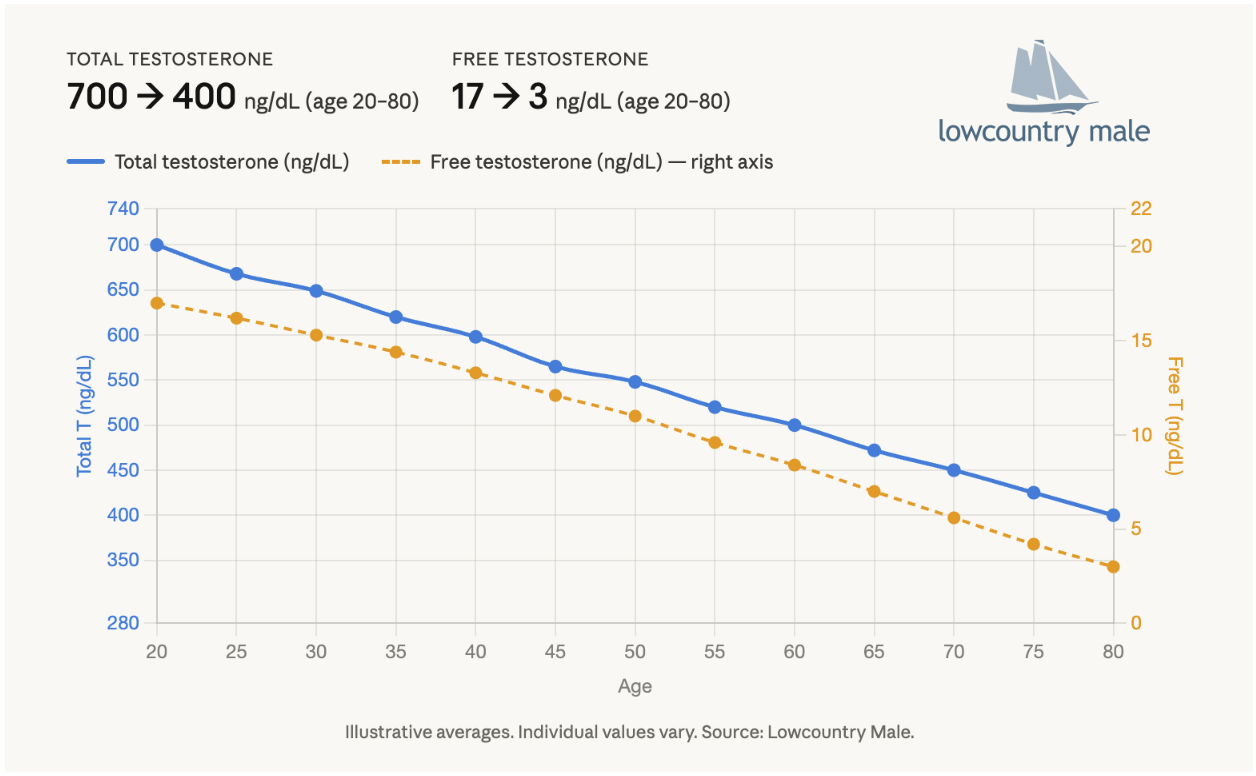
(Source: Lowcountry Male. Individual values vary.)
What Tests Give You the Full Picture?
A comprehensive hormone panel — the kind conducted in-house at Lowcountry Male — goes well beyond a single total testosterone reading. A complete evaluation includes:
- Total testosterone
- Free testosterone (direct measurement or calculated)
- SHBG
- Albumin
- Estradiol (E2) — estrogen balance directly affects testosterone function
- LH and FSH — to evaluate whether the issue originates in the testes or the pituitary
These markers together tell a far more complete story than any single number can. Because Lowcountry Male performs blood draws directly in the clinic, there’s no need to visit an outside facility — and results are reviewed by the same medical team managing your care.
What Can Be Done If Free Testosterone Is Low?
For men dealing with symptoms of low free testosterone, there are several clinical approaches worth discussing with a qualified provider. Depending on the root cause — whether it’s low production, elevated SHBG, or a combination — options may include:
- Testosterone Replacement Therapy (TRT) in various delivery forms: pellets, injections, oral, or topical cream, each with its own onset profile and impact on SHBG and free T levels
- Peptide therapy — certain peptides may support hormonal health and metabolic function, creating a better internal environment for testosterone to work as it should
- Peptides for testosterone support — for men who want to support their hormonal health before or alongside TRT
- Targeted supplementation to support SHBG reduction and testosterone bioavailability
- Lifestyle interventions that address insulin resistance, body composition, and metabolic health — all of which directly influence SHBG
The right approach depends heavily on your individual hormone profile and symptom picture, which is why a personalized evaluation matters more than a generalized protocol.
What to Do Now
If you’ve had your hormones tested and been told everything looks normal — but you don’t feel normal — the missing piece may not be your total testosterone. It may be your free testosterone, and the SHBG level that’s quietly keeping it locked away.
The better question to walk into your next appointment with isn’t “Is my testosterone normal?” It’s: “How much of my testosterone is actually available to my body?”
At Lowcountry Male, our comprehensive hormone panels measure total testosterone, free testosterone, SHBG, and additional markers that give you a truly complete picture. Our providers take a symptom-forward approach — because numbers on a page matter less than how you feel and function in daily life.
Schedule a consultation at Lowcountry Male and find out what your hormone levels are really telling you. With locations across South Carolina and Georgia — including Anderson, Charleston, Fort Mill, Greenville, Mount Pleasant, Myrtle Beach, Savannah, and Spartanburg — Lowcountry Male brings specialized men’s health care close to home.
Next up: How estrogen fits into the testosterone picture — and why balancing E2 is just as important as optimizing T.
RELATED ARTICLES

Boost Testosterone with Boron?
Can You Boost Testosterone with Boron? At Lowcountry Male, we’re committed to offering innovative, science-backed solutions to optimize vitality and...

Lowcountry Male Savannah, GA: Testosterone Replacement Therapy and Men’s Health
When it comes to men’s health in Savannah, Lowcountry Male is the clinic men trust to reclaim their vitality. Our Savannah location provides a...

Could Low Testosterone Be Worsening Your Seasonal Depression?
As the days grow shorter and the weather becomes colder, many men notice more than just a change in the weather; they may also notice a change in...
LET’S CREATE PROGRESS TOGETHER
Have a question? Please fill out the form below and we will be in touch within 24 hours.